bannière

bannière
Affichage des articles dont le libellé est Pat Mills. Afficher tous les articles

Fear And Loathing Collected Editions

All illustrations are © Kevin O'Neill & Pat Mills

Introduction


The goal of this article is to identify additional editorial elements included in the Fear and Loathing collected editions, i.e. paperbacks or hardbacks published in the US, UK, and Italy. The Marshal Law Deluxe Edition published more recently (2016) that includes the Fear and Loathing mini series is featured in its own article. The French edition collects the 6 issues in 3 volumes and is described in this article.

Both Fear and Loathing US and UK paperbacks, and the Italian version collect the 6 issues published initially by Epic Comics. The US Graphitti Designs edition also includes Marshal Law Takes Manhattan.


1990 U.S. Marshal Law TPB (softcover, Epic Comics)


A new cover was produced for this first collected edition.


Content (extra material)

  • an introduction by Clive Barker
  • 8 pages prologue (new material)
  • all six original virgin covers
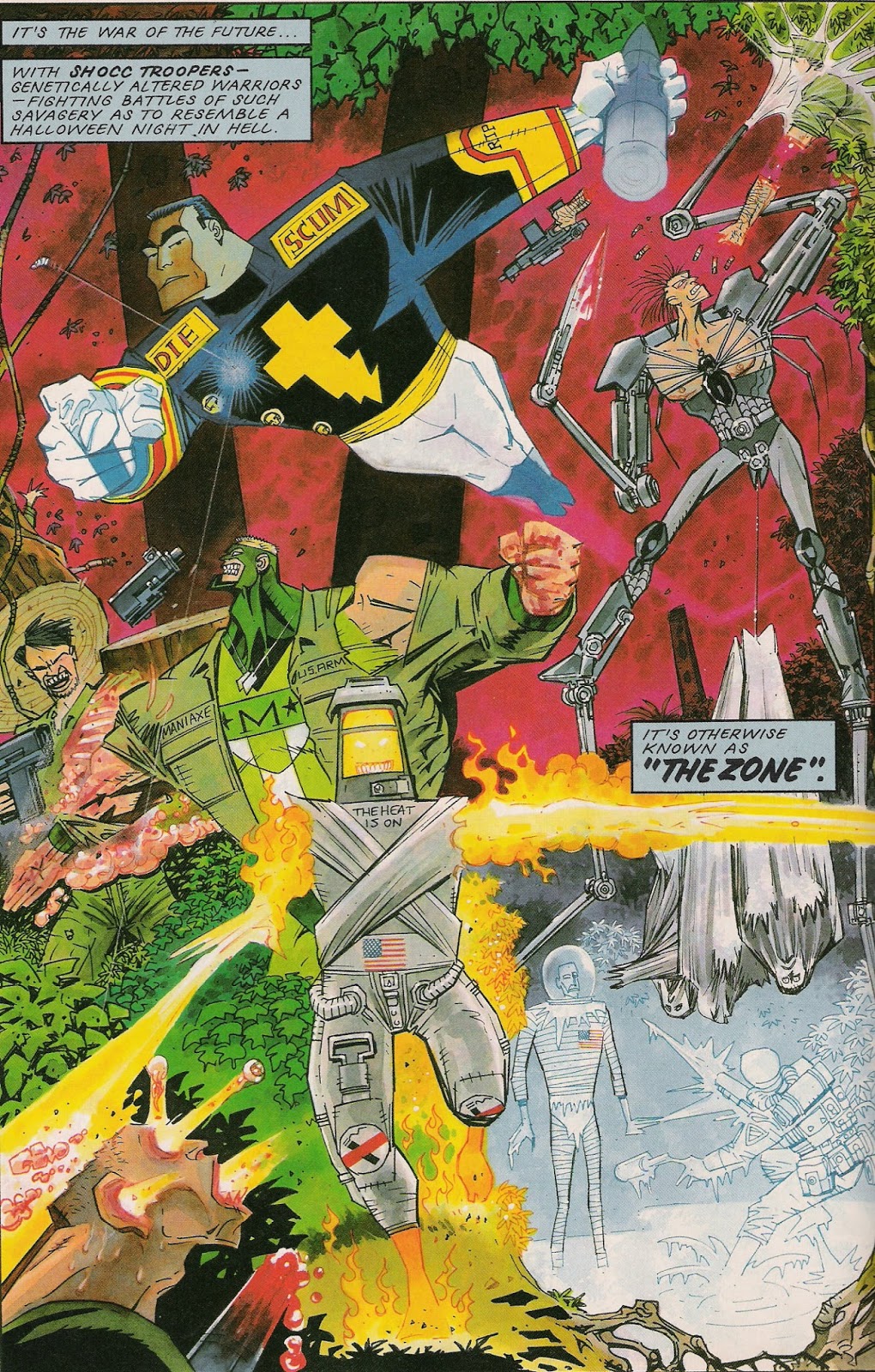
  • several new illustrations used as opening page, background for the credit page, and introduction page

opening page

credit page

illustration below the Clive Barker Illustration

Notice that the pictures used in the opening theatrical frames are not the same in this trade for issue #1 and #4 (original issues on the left, paperback reprints on the right):


1991 U.S. Marshal Law Limited Edition (hardcover, Graphitti Designs)


This signed limited edition has a numbered printing run of 1500 copies. It is signed by the two authors. It comes with a faux-leather hardcover and fully illustrated dust-jacket (front and back illustrations being newly produced for this edition).

front cover of the dust-jacket

back cover of the dust-jacket

It features an exclusive D. G. Chichester introduction printed on the flaps of the dust-jacket.


Here is the cover of the book without the dust-jacket (back cover being plain black with Graphitti Designs logo).


Second and third of covers illustrations have been taken from the French edition. Concerning the Fear and Loathing section, the main content of this book is similar to the US 1990 Epic TPB (opening pages, credit page, Clive Barker introduction, 8 pages prologue). At the end of the Fear and Loathing section, this new illustration has been added:


Content (extra material)


In term of extra material, this edition includes the D.G. Chichester introduction, an exclusive signature page illustration (see below), and 18 pages of bonus material commented by the authors (a few example below):
  • page 1: cover used for volume one of the French edition
  • page 2 to 5: O'Neill preparatory sketches and Mills plot proposal extracts
  • page 6: cover for UK magazine Strip #1 plus a small Archie Goodwin sketch (manager at Epic Comics)
  • page 7: frontispiece for volume one of the French edition plus early character notes on Marshal Law
  • page 8: cover for US magazine ARK #25, early character notes on Gangreen gang, and Suicida T-Shirt design
  • page 9: more rough designs and sketches, unused illustration for back cover of Epic TPB, and thumbnails from the original series
  • page 10: cover used for volume two of the French edition, early character notes on The Sleepman, and a few sketches
  • page 11: cover for UK magazine Strip #3
  • page 12: B&W illustration of the cover of Fantasy Adverstiser #109, illustrations used for the 100th issue of Speakeasy and volume four of Maxwell The Magic Cat, and early character notes on Celeste
  • page 13: illustration from the 1989 UK Comic Art Convention, early character notes on The Sleepman's Mother, and a small O'Neill drawing
  • page 14: cover used for volume three of the French edition and its frontispiece, early character notes on The Public Spirit
  • page 15: cover for UK magazine Strip #7
  • page 16: illustration for a Marvel Poster
  • page 17: O'Neill original pencils for some pages of Crime & Punishment
  • page 18: back cover used for volume three of the French edition


For more details about this edition don't hesitate to visit this other blog.


1991 Italian Marshal Law TPB (softcover, Play Press)


Italian edition published by Play Press in 1991 as Paura e Odio, Play Book #10.


The has the same size than the US 1990 TPB, and is printed on thick glossy paper (but a very poor glue was used so that all the pages detach rapidly and fall out).
Apart the Clive Barker foreword replaced by an introduction by the translator, Adam Centerbba, the content is the same as the US paperback.


2002 UK Marshal Law TPB (softcover, Titan Books)


The cover of this trade was originally used for the first volume of the french edition.


Comparing to the 1990 US Epic edition, this edition features the 8 pages prologue and the original covers in virgin form, but not its opening and credit pages. It only has one opening page illustration, the one showing the eye of the Sleepman produced for the Graphitti Designs edition.

Content (extra material)

  • two pages introduction written by Pat Mills dated 2002
  • eight pages of unpublished designs for a 1995 (not 1990) aborted film project (with authors bio)


Rites of Passage (Toxic! Magazine,1991)

All illustrations are © Kevin O'Neill & Pat Mills

Introduction


Between 28th March and 24th October 1991, Apocalypse Ltd had proposed a full color weekly magazine, Toxic!, with Pat Mills as editor, and Marshal Law as the leading story. The Hateful Dead story was indeed first published from #1 to #8.


During the weeks that followed the end The Hateful Dead pre-publication, many readers have wondered if ultimately Mills and O'Neill had not killed their character.


Doc Tox, who was in charge of the letter column never really contradicted them until the cancellation of the magazine with issue #31 (Apocalypse Limited went bankrupt).


Rites of Passage


To fill the magazine with marshal Law material before the next installment (that eventually never came as the magazine ceases to exist), the 8 page prologue first published in the Fear and Loathing paperback were reused in issue #14 and 15 of Toxic!.


Two unpublished pages were added to this prologue. The first new page published in Toxic! #14 is linked to the last panel of The Hateful Dead.


The last page of the prologue was originally designed to introduce the cover of the first issue of the original series.


The second new page published in Toxic! #15 provides a new sequence that turns back to the end of The Hateful Dead.


One could find these 2 new pages in the bonus section of the US Blood, Sweat, and Fears TPB published by Dark Horse in 1993 (note that the UK TPB of the same title, released by Titan Books in 2003, does not include these pages). The first of these two new pages (as well as a reprint of the cover of Toxic! #14) is also included in the bonus section of the UK TPB Fear Asylum (Titan Books, 2003).

The Hateful Dead (1991)

All illustrations are © Kevin O'Neill & Pat Mills

First edition


This 48 pages story was fully illustrated by Kevin O'Neill (pencils, inks and coloring), with lettering by Steve Potter. It is the first part (Rise of the Zombies) of a whole story that will concluded with Super Babylon. It was first pre-published in the fortnightly British magazine Toxic! (Apocalypse Ltd), through #1 to #8, between March 28 and May 16, 1991 (larger size magazine format with good quality paper).


This magazine was using the Marshal Law story as headliner for its launching. Indeed, the logo of the magazine appears in the story.


Marshal Law will make the cover for issue #1 and #5. For the first three issues, Kevin O'Neill was able to produce around 8 pages. From #4 to #8, this rate will fall between 4 and 6 pages, and then, apart two additional pages (see the Rites of Passage article) we will never see more new Marshal Law material in the magazine, that lasted 31 issues.

I have noticed in the first page of issue #6, an error with Black Scarab thought bubbles backgrounds that are red instead of yellow (see Toxic! #7). This was corrected for the release of the first paperback collected edition. Similarly, the Marshal Law logo used in each of the opening page in the magazine, has been further removed in the paperback.

Toxic! #6

corrected paperback edition

Below and left-hand side, Toxic! #2, right-hand side same panel in the paperback edition.


In 1991, Apocalypse Ltd, immediately released the paperback both in the UK and the USA, in comics format (softcover), with the Toxic! #5 cover (the cover for Toxic! #1 being used as back cover). It comes with a very good glossy paper and printing quality. It also features new illustrations for the second and third of cover.


Below second and third of cover for the collected edition.


back cover
It is worth pinpointing that the character design is evolving under the pen of Kevin O'Neill. He has became more and more elegant and stylized (we barely see the inverted cross on the mask of the hero during this adventure). Graphically, Kevin’s drawings look much closer to his more recent works (The League of Extraordinary Gentlemen). I also think that the original subdivision in mini chapters makes this story one of the most intense and entertaining.


Plot


Toxic wastes resuscitate superheroes buried in the San Futuro’s cemetery, and turn them into Zombies. Marshal Law is mostly responsible for the death of these so called heroes; nevertheless, he is pretty keen to do the work twice. Problem is, his former girlfriend Lynn Evans has been revived too.


Themes


As the character is now published in UK by Apocalypse Ltd and serves as the lead strip for a new weekly magazine, Marshal  Law is put back at the heart of the story. The key elements of his background are recalled in the very first pages: San Futuro, the war of "the zone", the earthquake.

The main missing character of this narrative will be his alter ego, Joe Gilmore, who will only appear in the last 2 pages, literally cannibalized by his costume counterpart. One can even feel that his parents are more those of the Marshal than his. This slight dehumanization is reinforced at the beginning the character is introduced by the sole means of his police function (his routines, his schedules). It will be explain that the thin thread that connected him to his feelings of compassion were broken when Lynn Evans was killed (the Marshal is somewhat "dead within"). And it is only because she will be resuscitated that Joe Gilmore will eventually reappear.


The main character evolution is actually the main theme. In this story it is about personalities suffering from not going "with the flow" (Razorhead, Marshal Law). Because despite being a cape hunter, he is nothing but a super hero himself, not so much different from the others (which is suggested in page 20, when the Marshal uses the services of costumed prostitute).

Beyond the Marshal's hatred for his fellow super-heroes, the hatred that he feels for himself is being more and more tangible, and that will lead him to the fatal gesture depicted in the very last panel. At the end of the story and for the first time, he will even show mercy towards another super-hero.


What's better for a "linving-dead" hero than the Zombies genre. If the story is initially very close to the film The Return of the Living Dead by Dan O'Banon (1985), it is strongly leaning towards the metaphorical approach used in George Romero's quadrilogy (Night of The Living Dead, Dawn of the Dead, Day of The Dead and Land of the Dead). In the modern society, we are already walking living dead. Unlike the more recent Marvel Zombies which uses only the concept (and 17 years before that), the authors use the inherent ideas behind the concept to dig deeper in the psyche of their character. Furthermore, the Zombies depicted by Mills and O'Neill, even if they too share a certain taste for human flesh, have kept their critical mind!


Finally, the first part of the story, which explores some of San Futuro's mean-streets, can be paralleled with the movie Cruising by William Friedkin (1980). The Hateful Dead deals also with an infiltrated cop into a particular sociological group (S&M homosexual New York community for the film, costumed heroes prostituting their powers for sado-masochistic humiliations in the comics), in order to investigate a series of murders, and where the hero will have to question is own assimilation to this community ("Go with the flow" or not?).


References

References to comic characters


I am surely not exhaustive, but here are the references I have spotted (mostly DC characters):

  • Green Arrow (see the picture above)
  • Superman (opening page and page 46)
  • A few Robin The Boy Wonder (page 11 and of course the Everest Character)
  • Captain Marvel and Mr Freeze (page 2)
  • Kitty Pride alias Shadowcat in an awkward position in page 6 


  • As for the great villain of this adventure, Black Scarab, it is an obvious reference to the Blue Beetle, the Charlton's Golden Age hero (this reference will have much more importance in the conclusion of the story Super Babylon), character that will be later transferred to DC. That said, the authors gave him a pronounced Batman look in order to accentuate the Batman & Robin aspect of Black Scarab/Everest couple.


Other References


  • The title itself, The Hateful Dead, is a nod to the Southern rock band "The Grateful Dead" (reversing the meaning of their name in the same time).
  • From the dedicated wiki page: Colma is a small incorporated town in San Mateo County, California, near the northern end of the San Francisco Peninsula in the San Francisco Bay Area. The population was 1,792 at the 2010 census. The town was founded as a necropolis in 1924. With most of Colma's land dedicated to cemeteries, the population of the dead — about 1.5 million, as of 2006 — outnumbers that of the living by nearly a thousand to one.
  • The links with Toxic! magazines are prevalent throughout the story: the magazine's logo is indeed made up of a barrel of toxic green fluorescent substance pouring on the title. It is the same barrels (affixed with the magazine title) and the same green fluorescent substance that are at the origin of the zombies plague in the comic. Similarly, the slogan used by the living dead "Go with the flow" will be used as one of the leitmotivs of the magazine.


  • Some movie references are explained in the themes section, but it should be added that the yellow / fluo green color of the toxic liquid used to resuscitate the dead recalls strongly the color of the fluid used by Dr. Herbert West in Reanimator (Stuart Gordon, 1985, an adaption of H.P. Lovecraft).


  • One of the corpse sculpture of Marshal Law's father's looks very much like the Guledig, seen in Pat Mills' Sláine.


Have you noticed?


Notwithstanding Kevin O'Neill's numerous juicy grafitti:

  • page 4, Marshal Law boot mark on Captain "Shazam" Marvel's crotch
  • page 8 a very useful fly-paper in Marshal Law's world


Some juicy quotes


  • Page 9, regarding Everest's precognition powers: "They say he’s so far sighted, he wipes his ass before he craps".
  • Page 12, some Marshal Law metaphysical insight: "I don’t like being a bastard…But they leave me no choice. That’s probably what god says".
  • Page 30, about a super-hero that cannot stand odd numbers: "He cut off his thumbs and big toes because he hated odd numbers …(That, too). Naturally I shot him three times".
  • And another delicious Marshal Law metaphysical insight (page 43): "And if this slime is right and there is no punishment in the hereafter …I’ll just have to give you your punishment now !"


  • And I have kept my preferred quote for the end (page 45):


Reprints


In 1993, Dark Horse Comics published this story in the Blood, Sweat, and Fears collected edition. If the paper is of very good quality, the colors are slightly less vivid than in the original one shot. This reprint includes the cover, back cover, and third of cover of the original Apocalypse Ltd one-shot with additional red coloring.


Blood, Sweat, and Fears was then reissued in the UK by Titan Books in 2003, with the Super Babylon cover, and without the minor coloring problem. This reprint includes the previous Dark Horse cover, plus the cover, back cover, and second of cover of the original Apocalypse Ltd one-shot.


Ten years latter, DC Comics have reprinted this story in its Marshal Law Deluxe Edition (hardcover edition in April 2013, softcover edition in December 2014).

HC edition

HC back cover

SC TPB edition
These reprints lack the back cover and third of cover of the original one-shot. You can find the detailed content of these two books here.

International publications

Italian Edition


This story has been published in Italy in 2014 by RW edizioni, as part of the translation of the 2013 US DC Deluxe edition in three volumes (here in the second softcover volume). Therefore this reprint lacks the back cover and third of cover of the original one-shot..


The translation has been redone and is credited to Susanna Raule.


Spanish Edition


The US DC Deluxe edition has also been translated in Spanish by ECC ediciones in three volumes.  The Hateful Dead is included in the second volume, and just like the US edition this reprint lacks the back cover and third of cover of the original one-shot. The translation is credited to Albert Agut Iglesias.